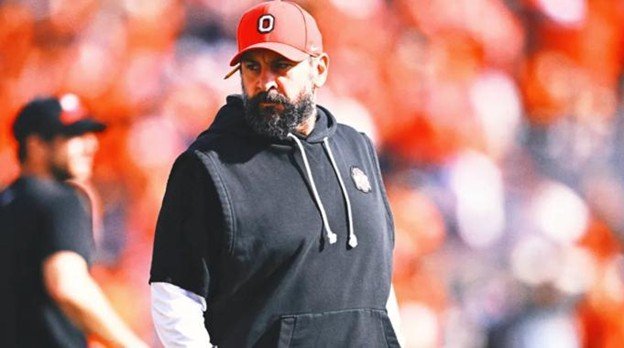
The 2026 NFL Draft ended Sunday. For Matt Patricia, the preparation started the day the 2025 season did.
The three days in Pittsburgh were a formality for Arvell Reese, Sonny Styles, and Caleb Downs. The real work happened in meeting rooms, on Zoom calls, and in individual sessions that Patricia organized from the moment the season ended. His job, as he saw it, didn’t stop when the final whistle blew. It extended through every step of the process that would determine where his players landed and how high.
That approach produced results. Three Ohio State defenders in the top 11 picks. Four in the first two rounds. Seven total in the draft. The numbers are historic by any measure.
Weekly Sessions After the Season Ended
Patricia was direct about his commitment to the process when he appeared on the Pat McAfee Show in late February. He told his players at the end of the season that they’d meet once a week through the offseason. He put them through mock combine interviews. He walked them through what a meeting with an NFL coaching staff looks like, what questions they’d be asked, and what teams are actually evaluating when they sit across from a prospect.
“Right when the season ended I told all the guys that we’re gonna meet once a week,” Patricia said. “I put them through the combine interviews and we kept that relationship going. You want your guys to have every chance to be successful.”
That’s not standard practice at the college level. Most coordinators hand players off to agents and draft prep programs once the season concludes. Patricia ran his own operation, drawing on 19 years of NFL experience to give his players a preparation advantage most college defenders never get.
Teaching the Why, Not Just the What
Caden Curry said it as directly as anyone could at the NFL Combine. “Coach Patricia’s been everything for me our whole senior year. He’s the guy that can do mock interviews with us because he’s been there before. He knows how to do everything the right way.”
The distinction Curry was pointing to matters. Patricia didn’t just prepare his players for interviews in theory. He prepared them with the specific knowledge of someone who sat on the other side of the table as an NFL defensive coordinator, evaluating prospects, asking the questions, deciding which players understood the game and which ones had only learned their own assignment.
Sonny Styles made the same point from a different angle. Patricia’s scheme, he explained, taught the defense conceptually rather than positionally. The terminology he learned in Columbus matched what he heard in NFL team meeting rooms during the pre-draft process. That overlap wasn’t coincidental. Patricia built his system to be transferable.
“The way he taught the defense,” Styles said, “a lot of these rooms I go in, it’s similar terminology, so they understand what I’m saying.”
The Bigger Linebackers Conversation
Patricia was particularly focused on Reese and Styles as they prepared for the draft, partly because of the stakes involved and partly because of how he viewed their upside.
“Those two linebackers are 6’5″, 6’4″,” Patricia said on the McAfee Show. “I’m like, you’re gonna get in the NFL whether I’m here or not. It doesn’t really matter. But how do you stay in the NFL? My whole thing to them was that we were gonna teach a little bit differently. We’re gonna teach more conceptually and we’re gonna learn the bigger picture. I think that’s one thing that will help them when they have to go into those new locker rooms and see those new schemes.”
That long-term view of player development is what separates Patricia’s approach from a coordinator who runs his system, wins his games, and moves on. He was thinking about where Reese and Styles would be in year three of their NFL careers while they were still running drills in Columbus.
What This Means for Recruiting
Every recruit who watched the 2026 draft saw something specific: a coordinator who develops players, stays connected through the process, and delivers results that show up on draft night.
Ohio State’s defensive recruiting has always benefited from the program’s NFL pipeline. Patricia adds a dimension to that pitch that no roster list or draft history chart can fully capture. He’s a coordinator who has been in the NFL rooms where these decisions get made, who understands what separates a player who lasts from one who doesn’t, and who treats the pre-draft process as part of his job rather than an afterthought.
For the next class of Ohio State defenders, that’s not a small thing. It may be the whole thing.